
Chapter Three
PROF AHMED BAKO’S STRUCTURAL ABUSE OF THE HISTORICAL PROCESS
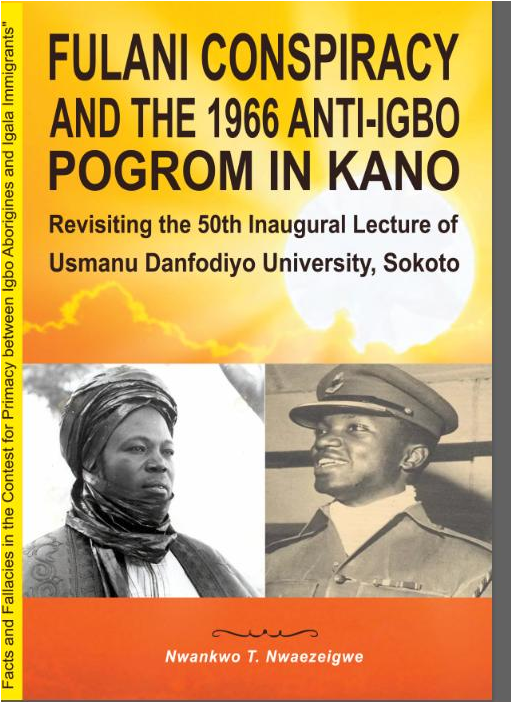
There are three basic structural elements any professional historian assessing any work of history like the present Inaugural Lecture by Prof Ahmed Bako or related disciplines, will first look at before going into the main text. The first is the title. The second is the table of contents; and the third the sources and bibliography which are generally referred to as references.
Beginning with the title, it is right to say that the title: “THE IGBO FACTOR IN THE HISTORY OF INTERGROUP RELATIONS AND COMMERCE IN KANO: Opportunities and Challenges Revisited” is structurally in accord with the thematic traditions of modern historical scholarship. But when the same title is compared with the thematic focus of the work within the text, it becomes an intellectual aberration.
In other words, the work does not present any factorial analysis of intergroup relations between the Igbo and other ethnic groups in Kano; rather it is a despicable narration of Igbo intent to dominate and appropriate the resources of their Kano hosts and, a derisive expression of Fulani historical hatred of the Igbo, without regard to the underpinning factor of positive Igbo contributions to Kano economic development.
The “opportunities” conveyed by the sub-title profoundly describe the Fulani opportunities in appropriating the pre-civil war Igbo investments and property in Kano State by the Fulani-led political leadership; while the “challenges” define the odious difficulties faced by the Igbo in Kano State to reclaim their economic attainments after the civil war.
There is therefore no doubting the fact that the title of the inaugural lecture is constructed on the pedestal of intellectual treachery driven by the inveterate historical hatred of the Igbo by the Fulani ruling class not just in Kano State but across the entire Sokoto Caliphate.
This intellectual treachery woven in intellectual dishonesty is profoundly conveyed by the clumsy and monotonous character of the Table of Contents in which he clandestinely omitted the fundamental factors of Igbo ethnic experience in Kano State—religion and anti-Igbo riots, in addition to religiously orchestrated murders of Igbo individuals. The deliberate omission of these two topical issues of intergroup relations in Kano State in particular and the Muslim North in general could indeed be likened to discussing Israel-Palestinian relationship without the October 7, 2023 atrocious Hamas massacre of defenseless Israelis.
How can a Professor of Nigerian history like Ahmed Bako discuss Igbo intergroup relations in Kano State without the 1953 Kano anti-Igbo riot? In fact as Isaac Olawale Albert rightly observed:
The relationship between the two groups has been frequently characterized by violence. Between 1953 and 1991, various riots took place in Kano involving the Kanawa and the residents of Sabon Gari. In most cases, the Kanawa were the aggressors. Until the 1982 religious riot, the Kanawa had often spared the lives of other non-Igbo Sabon Gari immigrants.[1]
Isaac Olawale Albert further informed us that at the end of the 1953 anti-Igbo riot in Kano, which indeed started as a political conflict between the Fulani-led Northern People’s Congress (NPC) and the Yoruba-led Action Group (AG) over a motion for Nigeria’s independence moved by Hon. Anthony Enahoro, that lasted four days, thirty-six people were officially recorded as killed and two hundred and forty-one wounded out of which 75 percent were identified as Igbo.[2]
These figures were however contradicted by a petition by the Jos Branch of Igbo Union which asserted that forty-six Igbo victims lost their lives with one community losing eight people. Indeed, the leader of Yoruba community and Action Group in Kano only confirmed three Yoruba indigenes killed. Was Prof Ahmed Bako telling us that the above episode was not worth mention or brief description in his horrendous historical exegesis in intergroup relations?
Furthermore, a critical and unbiased historian with professional integrity cannot discuss intergroup relations between Igbo immigrants and their Kanawa hosts without the mention of two Kano indigenes of duplicitous historical note— General Murtala Mohammed and his maternal uncle and former Minister of the First Republic Alhaji Mohammed Inua Wada.
Both men instigated and supervised the 1966 Igbo pogroms in Kano and the wider Northern Region, with Murtala Mohammed elevating that iniquitous wickedness against the Igbo to the October 7, 1967 gory Asaba massacre during the Nigerian civil war in which over two thousand defenseless Asaba indigenes were slaughtered in cold-blood.
This was how Ruth First described the unholy alliance of a wicked nephew Murtala Mohammed and his wicked uncle Alhaji Inua Wada in their horrendous bid to exterminate the Igbo not only in Kano but in entire Northern Nigeria:
Former Minister of Defence and NPC treasurer, Inuwa Wada, was ideally placed to do this. He had close contacts with Northern officers, having been responsible for the promotion of many of them; he was related to the most aggressive of the Northern army hawks, Colonel Mohammed Murtala, who was the NPC’s instrument among the military; and he had at his disposal large funds, from both the NPC treasury and his personal fortune, with which to buy influence.[3]
Does Prof Bako similarly feign ignorance of the October 1991 Anti-Evangelist Reinhard Bonnke riot against the Igbo in Kano that subsequently led to mass exodus of the Igbo from Kano? My mother’s only brother who survived the Nigerian civil war as a Biafran soldier and was employed by Blackwood Hodge Nigeria Ltd in Kano died in the course of his relocation from Kano following the 1991 anti-Igbo riot against Evangelist Reinhard Bonnke’s Crusade.
The intensity of the 1991 anti-Igbo Kano riot was such that President Ibrahim Babangida had to abandon the Summit of Commonwealth of Nations taking place then in Harare, Zimbabwe. According to the report of Newswatch issue of October 28, 1991, more than five hundred people were killed with countless numbers injured.
All the shops along Galadima Street, Court Road and other major streets housing Igbo businesses were destroyed and looted. In addition, over 300 motor vehicles and more than 300 motorcycles mostly belonging to the Igbo and other Christians were destroyed. For the first time in the history of anti-Igbo riots in Kano, the Igbo decided to fight back; which prompted quick Government intervention.[4]
On October 6, 2020, Yinka Odumakin asked one pertinent question with incisive revelations which has not yet been contradicted. That question was “Who Beheaded Akaluka?”[5] In 1995, the present embattled Emir of Kano Muhammadu Sanusi II, then known as Sanusi Lamido Sanusi and later Governor of the Central Bank of Nigeria, was said to have led a group of nine fanatical Kano Wahhabi Muslims who falsely accused a young Igbo trader named Gideon Akaluka of blasphemy and consequently mobilized irate Muslim mob who murdered him.
Gideon Akaluka who was initially arrested by the Police and placed in protective Prison custody was pulled out from the Prison custody by Emir Sanusi and his cohorts under the watch of the security agencies and murdered in cold-blood. He was subsequently beheaded and his head was hung on a spike in trophy fashion and paraded along the major streets of Kano under the leadership of Emir Muhammadu Sanusi II. It was for this reason that Emir Sanusi was clamped in detention for two years by General Sani Abacha.[6]
On June 2, 2016, an Igbo female petty trader at Kofar Wambai Market and wife of a Deeper Life Bible Church Pastor at No Man’s land, Kano, Mrs. Bridget Agbahime was murdered in the presence of her husband by a Kanawa Muslim mob over a false accusation of blasphemy. On November 3, 2016, Chief Magistrate Muhammad Jibril discharged and acquitted the five principal culprits in her murder, namely: Dauda Ahmed, Zubairu Abdullahi, Abdulmumeen Mustafa, Abdullahi Abubakar and Musa Abdullahi. To Prof Ahmed Bako, these episodes are not worth a paragraph or mere mention in his treatise on intergroup relations between the Igbo and his Kanawa.[7]
From the Table of Contents therefore one can rightly deduce that the work is an obtuse narrative of thematic Igbo commercial activities with fictional vilification of Igbo State Union and, allegorical compilation of select Igbo businessmen in Kano State. This was followed by periodic interruptions of spineless interventions of the Second World War and Nigerian civil war; rather than defined comparative analyses of Igbo economic competitions with other ethnic groups in Kano in relation to the periodic acts of violence against the Igbo.
Coming to the references as he describes his sources and bibliography, there are clear cases of methodological abuse of the rules of historical documentation that ordinarily would not have been expected from an undergraduate student of history, nay a Professor of History of more than four decade-experience.
Technically, the references are not ordered in alphabetical sequence in accordance with the canons of historical scholarship, thereby presenting a chaotic scenario. For instance, the archival and newspaper sources are not only undefined but placed at the tail-end of the references without reference to alphabetical order. The following are just few of the bibliographical anomalies noted in the lecture:
James S. Ojiaka, Thirteen Years of Military Rule, 1966-1979, A Daily Trust Publication, Lagos, 1978, is not only placed in a wrong place against alphabetical order but duplicated in another place as James S. O., Thirteen Years of Military Rule , 1966-1979, A Daily Trust Publication, Lagos, 1978.
Nwaugo, F.N. (2006), Igbo Spare Parts Entrepreneurs in Metropolitan Kano: A Model for Inter-group cooperation in a plural society, 1970-2001; Meek, C.K. (1971), The Northern Tribes of Nigeria: An Ethnographic Account of the Northern Provinces of Nigeria together with a report on 1921 decimal census, Frank Cass; and Sanusi L. S. ‘Kano Political Economy: Reflections on a crisis and its resolutions’ In Perspectives on the Study of Contemporary Kano, ABU Press, are duplicated in the same reference at difference positions against the alphabetical order; with no date and no coma after surname included in Sanusi L. S. Equally, Muazzam, “Preliminary Notes on the Kanawa Identity: Beyond Indignity”, In Citizenship and Indignity Conflicts in Nigeria, has incomplete bibliographical information.
Lugard, F.D., Political Memoranda: Revision of Instructions to Political Officers on Subjects Chiefly Political and Administrative, 1913-1918, and Lubeck, P.M. (1986), Islam and Urban Labor in Northern Nigeria: The Making of a Museum Working Class, are not only placed against alphabetical order but chaotically placed between Nwaugo, F.N. (2006), Igbo Spare Parts Entrepreneurs in Metropolitan Kano: A Model for Inter-group cooperation in a plural society, 1970-2001 at the top, and Meek, C.K. (1971), The Northern Tribes of Nigeria: An Ethnographic Account of the Northern Provinces of Nigeria together with a report on 1921 decimal census, below.
Most questionable is the fact that of the plethora of published sources on the Igbo in Kano and related subjects, only three of such publications— Chukwuemeka, Onwubu, ‘Ethnic Identity, Political Integration, and National Development: The Igbo Diaspora in Nigeria’, The Journal of Modern African Studies, 13, 3 1975; Olusanya, G.O. ‘The Sabon Gari System in the Northern States of Nigeria’ Nigeria Magazine, 94, September, 1967; and Osaghae, E. E. (1994), Trends in Migrants Political Organization in Nigeria: The Igbo in Kano, IFRA, were noticed in his references; an omission that readily puts the inaugural lecture to scholarly questions. Indeed, of the six sources under Prof Ahmed Bako’s name in the references, only two are published and by his local Departmental journal “Degel: Journal of FAIS.”
It is a great dishonor to the intellectual tradition of historical research that in such a work as this, notable sources of historical importance are deliberately omitted for unexplained reasons. Among these are:
Albert, Isaac Olawale “Ethnic Residential Segregation in Kano and its Antecedents”, African Study Monographs 17(2), 85-100, October 1996
Albert, Isaac Olawale Inter-ethnic relations in a Nigerian city: A historical perspective of the Hausa-Igbo conflicts in Kano, 1953-1991, Ibadan: IFRA-Nigeria, 28 Janvier 2022
Albert, Olawale “Kano. Religious fundamentalism and violence” Jeunes, culture de la rue et violence urbaine en Afrique/Youth, Street Culture and Urban Violence in Africa, Actes du symposium international d’Abidjan, 5-7 mai 1997/Proceedings of the International Symposium held in Abidjan, 5-7, May, 1997
Albert, Isaac O. “The Socio-Cultural Politics of Ethnic and Religious Conflicts,” in Ernest E. Uwazie, Isaac O. Albert and Godfrey N. Uzoigwe, eds., Inter-Ethnic and Religious Conflict Resolution in Nigeria New York: Lexington Books, 1999
King, Lamont “From Caliphate to Protectorate: Ethnicity and the Colonial Sabon Gari System In Northern Nigeria” Journal of Colonialism and Colonial History, Volume 4, Number 2, Fall 2003, 10.1353/cch.2003.0044
Allyn, David E. “The Origin of the Sabon Gari System in Northern Nigeria” Issue 2 of ASA Annual Meeting Papers, 1975
Mamuda, Abdulaziz; Sani, Tasi’u Ashiru & Kabiru, Mustapha “A History of Migration: The Emergence of Gobirawa Enclave in Kano since the 19th Century” Lapai Journal Of Nigerian History, Volume 13 Number 3
Usman, A. F. “Implications of Colonial Settlements on Inter Ethnic Relations: Case Study of Sabon Gari Kano” International Journal of Humanities and Social Science Vol. 5, No. 10; October 2015
One can therefore assert that the inaugural lecture falls short of the optimum intellectual standard of historiography required for objective historicism in inter-ethnic relations between the Igbo and their Kanawa hosts. Indeed, from every surgical point of assessment, Prof Bako engaged in what could rightly be described as one-way traffic historiography with the superficial intellectual dogmatism of a Muslim mullah.
There is also no arguing the fact that by such unscholarly historiographical omissions and tendentious trajectory of the work, Prof Ahmed Bako deliberately covered up some fundamental components of historical evidence that clearly question his obtuse narratives. He also deliberately introduced some ahistorical contraptions with the aim of obfuscating historic positive Igbo contributions to the overall development of Kano State more than any other ethnic group, and by extension further provoking the acculturated pervasive hostility against the Igbo by the Kanawa and their Northern Muslim kinsmen.
[1] Isaac Olawale Albert, Inter-Ethnic relations in a Nigerian city A Historical Perspective of the Hausa-lgbo Conflicts in Kano, 1953-1991 Ibadan: IFRA-Nigeria, 2022, 2
[2] Albert, Inter-Ethnic relations in a Nigerian city A Historical Perspective of the Hausa-lgbo Conflicts in Kano, 1953-1991
[3] Ruth First, THE BARREL OF A GUN: Political Power in Africa and the Coup d’Etat Part V– the Soldiers Invade: coup casebooks London: Penguin Press; 1970, 313, (Present edition by Ruth First Papers, 2012), www.ruthfirstpapers.org.uk
[4] Albert, Inter-Ethnic relations in a Nigerian city A Historical Perspective of the Hausa-lgbo Conflicts in Kano, 1953-1991, 9; Newswatch October28,1991, 15-16
[5] Yinka Odumakin, “Who Beheaded Akaluka?” Independent Oct 6, 2020,https://independent.ng/who-beheaded-akaluka/
[6] Odumakin, “Who Beheaded Akaluka?” Independent Oct 6, 2020
[7] CSW, 11 November, 2016, https://www.csw.org.uk/2016/11/11/press/3338/article.htm
https://shorturl.fm/Ijawf
https://shorturl.fm/3SUqN
https://shorturl.fm/YjlkL
https://shorturl.fm/FDEXu
https://shorturl.fm/6CjP3
https://shorturl.fm/ySQ22